
Build Your Own Green Screen Kits
How to Build Your Own Green Screen Kits
Thank you Ryan O'Donnellfor this very helpful and informative blog post on Building your own Green Screen Kits for your school. Ryan took on the task of creating Green Screen kits that could be used for his whole district. So any of the teachers could take out a few of the kits and easily put together a great learning project for their entire class. They also have multiple kits, so students in these higher ed classes could use them in groups and didn’t have to be waiting for other students to finish.
The cost of all of these are pretty minimal. I mean seriously… PVC pipe is less that $3. Now, if you have iPads and covers, the biggest cost you will have is the fabric and that is very reasonable. To really do this well though, I recommend doing MULTIPLE kits. therefore your student can work in groups and not feel rushed.
We hope you get some great ideas from Ryan O’Donnell’s Green Screen kits and it helps you with your next Green Screen project!
Affordable Green Screen Kits. Before we dive into the DIY setups, it’s worth mentioning that simple green screen kits are cheaper than ever. When I was in college, the “YouTube” green screen kits were not available, so I frequently had to DIY my own. The truth is, these modern kits are going to be better than most DIY setups. Beginners can buy a starter green screen or green muslin backdrop cloth for as low as $20. Most hobbyist and semi-pro green screens come with a photo or video lighting kit that costs several hundreds of dollars. Professional green screen backdrops can cost thousands by themselves depending on their size. Taller screens usually have higher prices. Make videos with the best lighting using the included 8” LED ring light with 3 different color modes and 10 dimmable brightness settings; Capture your best angles with the adjustable smartphone holder and extendable tripod; Create custom backgrounds using the included green screen paired with your favorite editing app! Compatible with most.
Cover image via

From setting to lighting: we discuss several tips on how to create a green screen background — without breaking the bank.
Most of Hollywood’s big-budget action, fantasy, and sci-fi films rely on the humble green screen. However, Hollywood green screens are anything but humble. From huge cyclorama sets to full-body green screen suits, most scenes in these films come to life in post-production with the help of advanced green screen techniques. Many filmmakers are eager to achieve the same effects, but it requires a thorough understanding of green screen sets and chroma keying. For everything on this topic, check out our guide to green screen.
The good news is that you don’t need a huge budget or complicated equipment to create a green screen set with convincing results. Whether you’re on a shoestring budget, or you’re just in a bind, there are several ways to DIY a green screen setup. We’ve put together a list of creative solutions for both the green screen backdrop and how to light it.
Affordable Green Screen Kits
Before we dive into the DIY setups, it’s worth mentioning that simple green screen kits are cheaper than ever. When I was in college, the “YouTube” green screen kits were not available, so I frequently had to DIY my own. The truth is, these modern kits are going to be better than most DIY setups. They’re usually priced around $100 or less. If you already know you want a kit, or we just convinced you to get one, check out our breakdown of the best green screen kits on the market (for every type of user). We’ll list a few options below, too.

The YouTube Kit
Green screen setups — like this Emart kit — are what I commonly refer to as “YouTube Kits.” That’s because these kits are popular with entry-level YouTubers, or anyone who just wants a simple, all-inclusive kit to get the job done. Are these kits going to be top-notch quality? Nope. But, compared to most DIY setups, they’ll be cheaper and more effective.
The YouTube kit is cost effective and a good go-to resource.
Many of these kits include the following: backdrop stands and support bar, green screen cloth backdrop, lights with stands, light diffusion, clamps, and a carrying case. For the price, these kits are incredibly difficult to beat. A standard roll of seamless background paper can often cost more than these kits.
Popup Green Screen
Portable “pop-up” green screens — like this one from Fancierstudio — can provide fantastic results. This is actually the type of green screen I use most frequently, due to its simplicity. Because of the collapsible pop-up design, the fabric becomes taut when expanded, which creates little to no wrinkles on the backdrop. This makes keying out the green screen in post-production much easier.
The pop-up green screen is taut when expanded, resulting in a smooth backdrop.
Pop-up backdrops are usually dual-sided, with one side being green and the other blue. They typically cost around $40.
DIY Green Screens
Now that we’ve seen how affordable modern green screen kits can be, let’s explore some DIY options. For these DIY options, the idea is to create a green screen solution that costs even less than the kits available. In some cases, we’ll be looking at what free options are available. When it comes to building a green screen for less than $100 (or even $40), you need to think creatively. In the following sections, we’ll cover every part of a standard DIY green screen kit, including the following:
- Green screen backgrounds
- Lighting
- Mounting and stands
DIY Green Screen Backgrounds
Fabric from Craft Stores
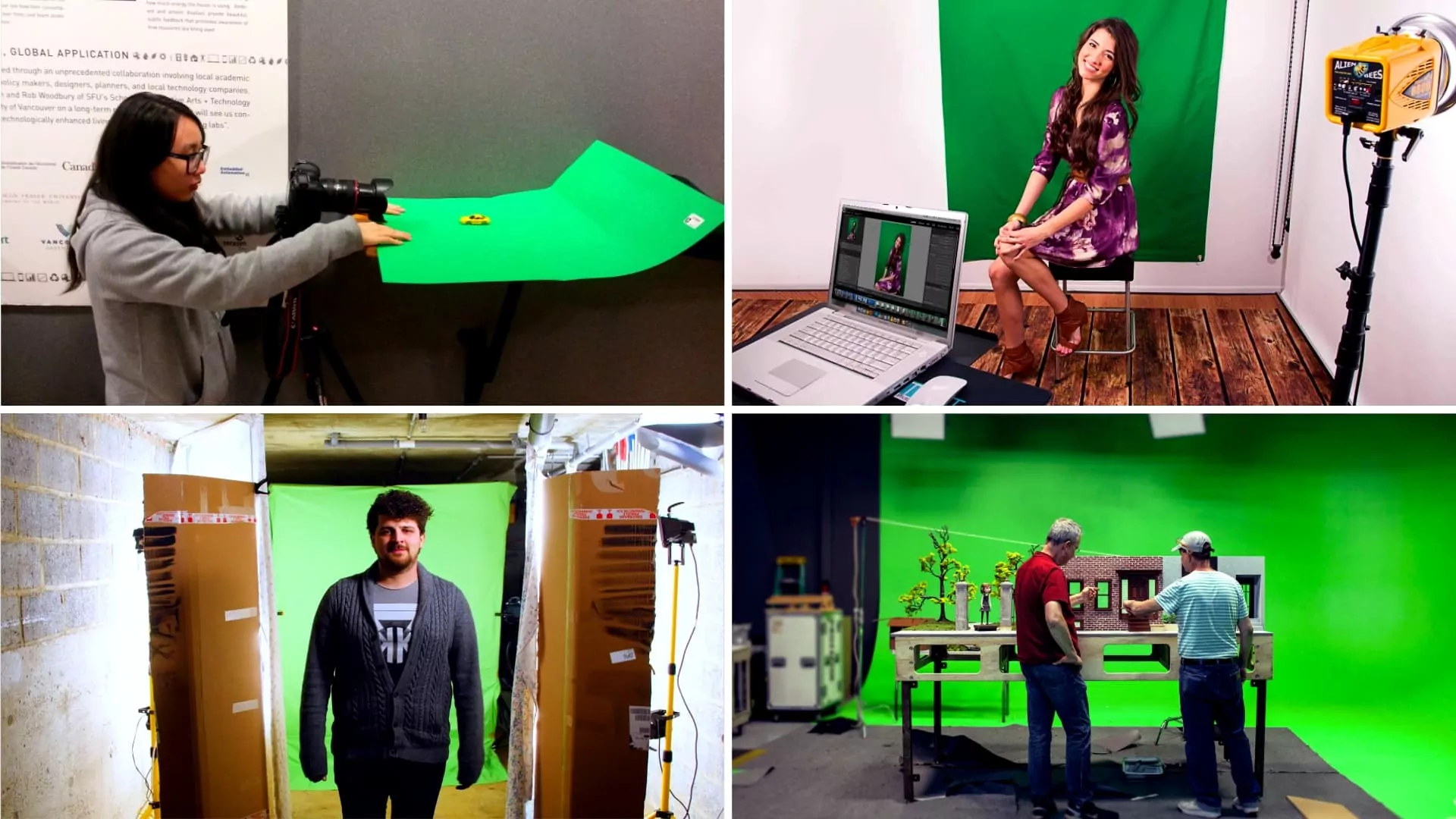
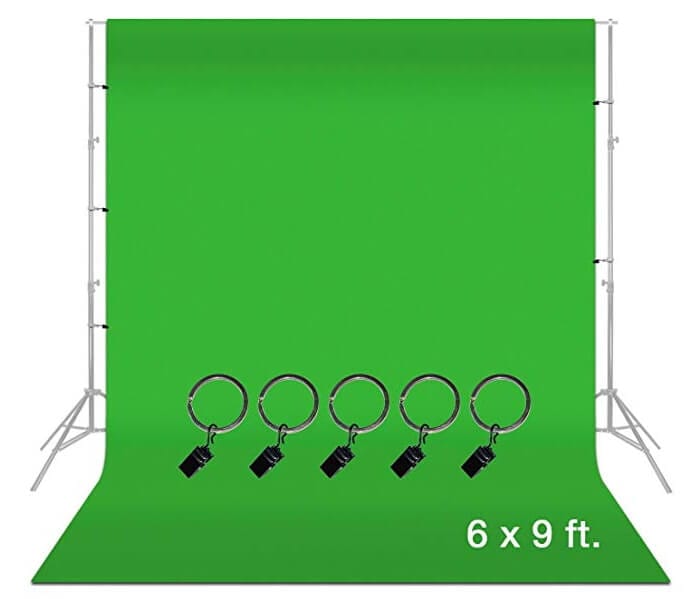
A fabric backdrop is your best bet for a DIY green screen. Craft stores will usually have large rolls of solid green and blue fabric you can choose from and cut to your own specifications. Buying fabric this way is fairly affordable, too.
Build Your Own Green Screen Kits Free
Craft store fabric is easy to access and inexpensive.
As you browse for fabric, keep an eye out for the type of material. Heavy fabric will hang nicely and provide solid coverage. But it will also be more prone to creasing and wrinkles. Light, stretchy fabrics resist wrinkles well, but they might not offer the same coverage as heavier materials. Avoid shiny fabrics, like polyester satins, which will reflect light and create unwanted “hot spots” on your background.
Be prepared to iron out any wrinkles and creases that may appear on the fabric. It needs to be completely smooth and wrinkle-free to ensure the best key possible. You’ll also need to figure out a method to hang the fabric. We’ll touch on this more later, but some common solutions include hanging nails, large thumbtacks, or using a line and clothespins.
Colored Foam Poster Board
Another thing you can find at craft stores is colored foam poster board. You can usually find these in blue and green colors, as well. They probably won’t be large enough for a person to stand in front of, but if you’re filming items on a table from above, they’ll work fine.
Craft store foam poster board will also work as a backdrop.
Avoid any poster board that has a glossy surface, as it’ll probably reflect too much light and be difficult to key in post. I also don’t recommend using multiple pieces of poster board together to create a large backdrop because there will be seams where the boards meet. However, in a pinch, you may be able to make it work. It’ll just require more work in post-production.
Poster board is a great option when you need to key out smaller areas of a shot – like a TV or monitor screen. You can easily cut the board to size and position it without fussing with fabrics.
Solid-Colored Walls
If you happen to have a free-standing flat, or a spare wall available, you can paint it green or blue to achieve an easy DIY green screen. This is also a viable option for floors, so you can create an entire green screen set. The wall or floor must be smooth and flat, and the paint you choose must be a matte or matte enamel finish. Matte paints won’y reflect any light, but they’re hard to clean. Matte enamels are a bit glossier, and therefore more reflective, but they’re easier to clean and more durable — this is the paint you typically see in bathrooms. When you’re picking a color, opt for bright and light greens and blues.
If necessary, you can use a plain, solid-color wall as your key background without painting it. Ideally, it will be an interior wall that’s smooth and isn’t too close in color to skin tones. The wall color doesn’t have to be green or blue; those colors are just ideal for keying in post because they’re the farthest away from skin tone colors. You can use any color as a key — obviously some more effectively than others. Experiment with this, but it’s likely a last-resort solution.
DIY Lighting
Filming Outside
The best DIY lighting for green screens that I can recommend is free — just film outside. I actually do this all the time with a popup green screen I have mounted on a C-stand. This is really effective. Filming in mid-day will provide plenty of light, and the shadows should fall below your subject, not on the green screen.
Use your free light source by setting your popup green screen outside.
You can easily adjust the angles of your background and subject if shadows become an issue. Also, if it’s a cloudy day, it’ll actually diffuse the sunlight, reducing the shadows even more. If you’re a filmmaker on a budget, I can’t recommend this solution enough!
Work Lights
The most common solution for cheap lighting is going to be construction work lights. You’ve probably seen these before. They’re usually dual lights mounted on a bright orange stand. I don’t actually recommend lighting your subject with these lights, as they’re very harsh. But they work for lighting up your background. These 2,500 watt Woods Twin Head Work Lights are a classic example.
Construction work lights are inexpensive and great for lighting your background.
A word of caution, though: If you do decide to use lights like this, be very careful. Work lights are designed for raw-lighting power, which means they can get extremely hot and easily burn you. Be sure to use heat resistant gloves when working with them. Personally, I don’t think they’re worth the trouble (when compared to the YouTube green screen kits or just filming outside).
The Olafus Work Light is LED-generated; therefore, it doesn’t generate as much heat and is safer to use.
Alternatively, you might want to look for LED work lights — like this Olafus Work Light. Since they use LEDs, they won’t generate as much heat, and they’re likely safer to operate.
DIY Mounting and Stands
Clothesline and Clothespins
Hanging your backdrop from a clothesline is easy and inexpensive.
Whether you’re mounting your backdrop inside or outside, using a clothesline and clothespins is one of the easiest and cheapest methods. Simply toss the fabric backdrop over the line, then secure it with the clothespins. You may want to hang clothespins or spring clamps off the bottom of the fabric as well, to keep it taut and wrinkle free.
Wire Nails or Thumb Tacks
Hang your backdrop on an interior or exterior wall using wire nails or thumb tacks.
If you’re hanging a fabric backdrop on a wall indoors (and you want to minimize impact to the wall), use wire nails or large thumb tacks to hang the backdrop. These should hold the fabric well and the size of the holes left in the wall won’t be noticeable. You can pick up a pack of these for a few dollars. Again, just make sure the fabric is taut to prevent wrinkles.
3M Hanging Strips
An alternative to nails, mounting tape is great for hanging poster boards or fabric.
3M Hanging Strips are great if you’re mounting poster board to a wall. They’re designed to hold up picture frames, and you can easily remove them from the wall with no damage. Some even have hooks, which you could use as an alternative to nails if you’re hanging a fabric backdrop.
Use What You Have
When it comes to stands to hang things from, use what you have available. (But do it safely, of course.) You can use coat racks, doors, or door jambs to hang or drape a background. And, if you’re outdoors, you can always tie a line between two small trees, fence posts, carport poles, etc.
Build Your Own Green Screen Kits Do-it-yourself
Get more green screen content!